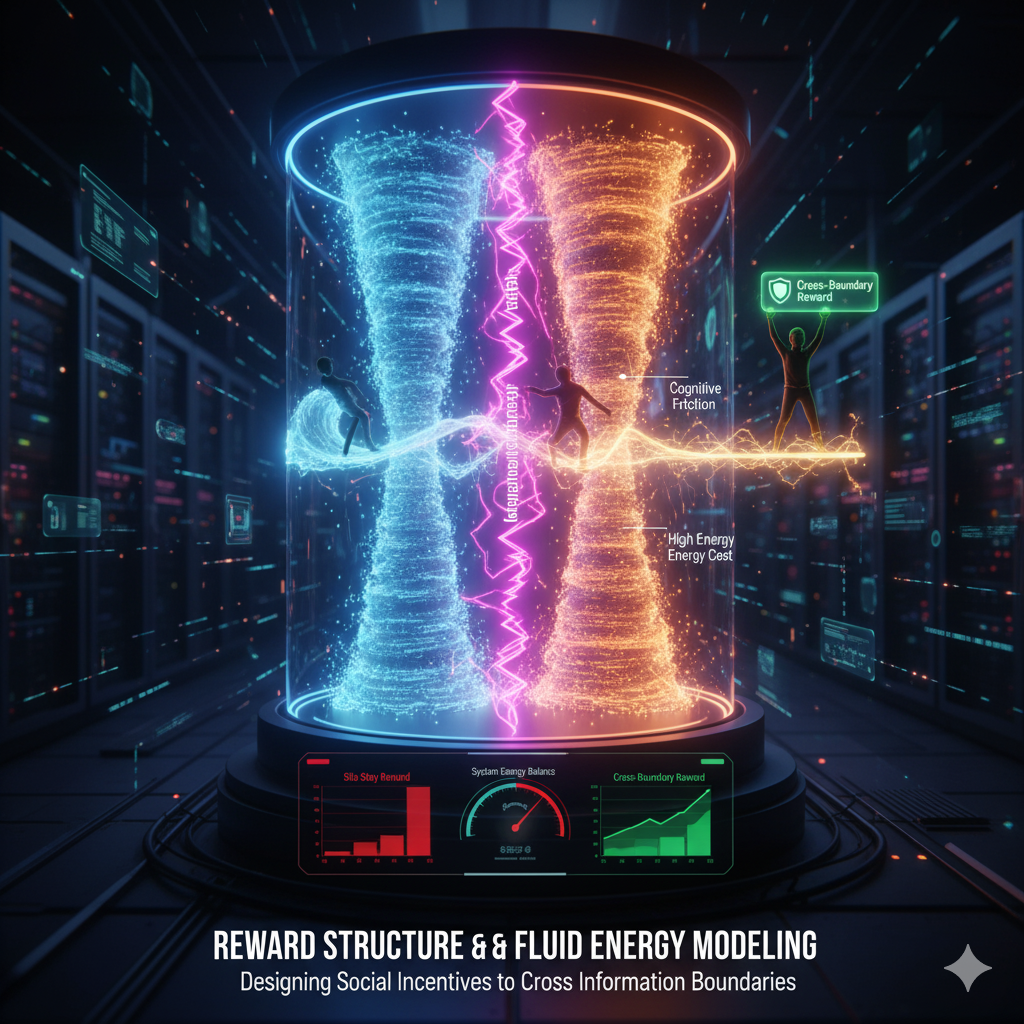
I. Introduction: The Energy Challenge of the Silo
In the first two parts of this series, we diagnosed the chaotic state of the social opinion flow ( Re) and its solidified structure (LCS). We found that the information silo is an “eddy” meticulously constructed by algorithms—an energy-closed system.
Now, we face the ultimate question: How do we encourage individuals to expend energy and bravely cross these LCS boundaries?
The answer lies in two seemingly unrelated fields: the reward structure in cognitive psychology and fluid energy modeling in physics. Only by redesigning the energy landscape of social interaction can we achieve true information mixing.
II. Core Concepts: Energy, Reward, and the “Path of Least Resistance”
We must view human motivation as a form of energy flow:
A. Cognitive Reward Structure (Psychology)
- Fuel of Motivation: Neuroscience tells us that human behavior is driven by Dopamine, which rewards us for seeking predictable, immediate gratification.
- Algorithm’s Perfect Exploitation: Social media algorithms reward “Internal Coherence“. Seeing one’s preferred views affirmed is an immediate, cheap Dopamine reward—this is the path of least cognitive resistance.
B. Fluid Potential Energy (Physics)
- System Tendency: In fluid dynamics, systems always tend to move to the lowest potential energy state.
- Silo’s Attraction: The information silo is precisely this system’s lowest potential energy trap. It offers stable information and immediate emotional resonance (low cognitive friction), requiring the least energy input.
- High Cost of Mixing: Crossing the LCS boundary to encounter dissenting views means huge cognitive friction, social exclusion, and emotional anxiety. This is the high potential energy path.
Diagnosis: Our current social reward system is an energy trap, incentivizing individuals to remain in the lowest energy state (the silo) by maximizing cheap rewards (Dopamine).
III. Diagnosis: The Imbalanced Energy Budget
The current digital platform’s reward budget for information mixing is negative:
| Action | Energy Input (Cost) | Reward Output (Gain) | Outcome |
| Stay in the Silo | Extremely Low (Minimal cognitive friction) | Extremely High (Immediate, emotional Dopamine) | Severely reinforces LCS |
| Cross Boundary and Mix | Extremely High (Cognitive friction, social exclusion) | Extremely Low (Negative feedback, anxiety, cancellation) | Prevents mixing, exacerbates polarization |
We cannot expect individuals to continually choose high-cost, negative-reward behaviors for the sake of “social responsibility”. The only way out is to redesign the energy budget.
C. Historical Case Study: The Energy Exhaustion of the Communist Movement (History & Philosophy)
This failure of the “energy budget” is not unique to the digital age. The decline of the communist movement in history is the most grand validation of this model.
- Exhaustion of Cheap Reward: In the early days of the revolution, hatred of the wealthy was an immediate, systematized “cheap Dopamine”. It drove powerful social turbulence through simple friend-or-foe categorization (high coherence).
- Explosion of Long-Term Costs: Once the revolution succeeded, this emotional reward could not replace material rewards. The inefficiency of the central planned economy led to long-term resource shortages, queues, and unfair distribution. Maintaining this “energy-closed” LCS required continuous political fear (extremely high social viscosity cost).
- External Shock and Collapse: When the external world (e.g., Western consumerism) offered more efficient and predictable material incentives, the old ideological LCS could no longer maintain its energy closure. Individuals, acting as “motivational fluid,” naturally flowed toward the new “lowest potential energy trap”—namely, personal wealth and free choice—leading to the collapse of the old structure.
This historical lesson shows that any social structure that fails to provide a sustainable, efficient reward system matching the input is destined to be replaced by a new energy landscape.
IV. Proposal: Designing an “Adaptive Incentive Structure”
We must artificially intervene to change the energy landscape of information mixing, transforming it from “highest cost” to “optimal output”.
1. Reward “Cross-Boundary Flow” (Lowering the Cost of Mixing)
Incentive mechanisms must shift from “attention” to “Bridging Potential”.
- Indicator Reconstruction: Introduce the “Cognitive Friction Score“. Instead of rewarding users for dwelling in their comfort zone, reward them for successfully and constructively engaging in conversations with a high LCS distance.
- Specific Implementation: Platforms should not just reward “likes” but reward:
- “Cross-Tribe Citation”: Higher exposure and rewards when your content is positively cited or replied to by user groups known to be in an opposing LCS.
- “Critical Viscosity Badge”: A reward of social capital given to individuals who maintain neutrality, rationality, or offer constructive viewpoints when addressing highly divisive topics.
2. Punish “Closed Energy Circulation” (Raising the Cost of Internal Consumption)
- Energy Tax: Content that only circulates within a closed LCS and is high in negative emotion should have its algorithmic exposure weight reduced, or its recommendation frequency decreased after a certain period, thereby raising the potential cost of maintaining a closed loop.
- Cognitive Dissipation Alert: Similar to warning for speeding, when a user is continuously in a high-emotion, low-information-value closed loop, the platform should intervene moderately with a “Cognitive Dissipation Alert”, encouraging rest or entry into neutral information zones.
V. Conclusion and Meaningful Proposal
The only solution is not censorship, but energy engineering.
We cannot change the human instinct to seek rewards, nor can we reverse the high speed (Re) of information flow. But we can use our understanding of fluid dynamics and cognitive structure to reprogram the energy flow within the system.
The Historical Revelation: Using Precise Energy Shock to Disintegrate LCS
In the 1970s, the Soviet Union used a nuclear bomb to extinguish an out-of-control oil well fire. This seemingly insane act was driven by the logic of energy engineering: High-energy turbulence that cannot be controlled (the oil fire) requires a calculated, precise, counteracting energy input (the nuclear shockwave) to instantaneously cut off the fire’s oxygen supply and completely change the combustion environment, thus achieving system stabilization.
For the information silo, this Dopamine-driven “combustion vortex,” we need a similar “energy shock”. We cannot expect the algorithm to self-correct; we must implement an “Adaptive Incentive Structure,” which, like a nuclear shockwave, instantaneously changes the information’s energy landscape, making crossing the $\text{LCS}$ the new, more attractive lowest potential energy path.
My proposal is: Incorporate the “Adaptive Social Incentive Structure” into the design blueprint of the next generation of AI algorithms. We must make the behavior of “learning difference” cognitively “cheap and efficient” and socially “noble and valuable” at the macro level.
This is not just a technical problem; it is a challenge for NeuroLaw: We must use our wisdom to correct the physical structure, created by ourselves, that has constrained human free will.
Leave a Reply