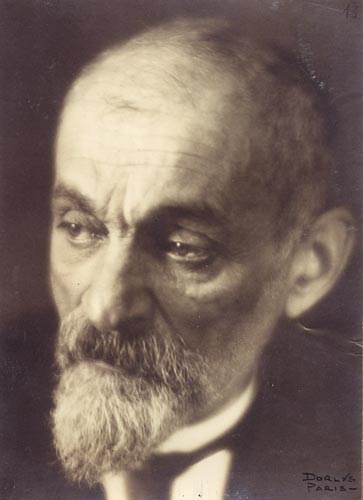
When we open Shestov in this shattered age—
whether it is Athens and Jerusalem or In Job’s Balances—
the air seems to flicker with a strange reflected light.
It is not the light of scholarship, nor the glow of systems,
but more like the last flare of a civilization’s embers before they go dark.
In that dim light we can still make out several ancient towers
standing across time:
the luminous Ideas of Plato, the fire of freedom in Jesus,
the primal chaos of the Tao Te Ching,
and the silent abyss at which the mystics gaze.
Shestov stands precisely where the shadows of these towers cross.
He is a thinker of the Silver Age—
one who still receives the light of the Golden Age,
yet feels that light draining away from the world.
His writing always aims at the fractures of civilization:
on one side, Plato’s iron curtain of necessity;
on the other, the abyss of freedom opened by Jesus’ “I Am.”
And we—
we live in a time darker than his,
a more fractured epoch he could not have imagined,
an age of Black Iron.
In the imagery of Greek myth,
gold is followed by silver, and silver by iron.
If Plato and Jesus belong to gold,
and Shestov to silver,
then we are iron—
those who pick up fragments in the ruins.
This text is written from the vantage point of Black Iron:
a way for readers of this age
to use the lights of chaos, freedom, and revelation
to illuminate, once more, that “thinker in the fracture.”
I. The Silver Age: A Thinker in the Dying Light
Shestov lived at a time when the old sky had not yet fully collapsed,
and the new sky had not yet risen.
Rationalism, forged by Kant, had reached its peak,
but cracks were already spreading from within.
The original Christian flame of freedom
had been wrapped in institution and doctrine until only a faint heat remained.
The clear wind of the Tao Te Ching still blew,
yet the metallic smell of modernity was already all-pervasive.
Shestov stands on that fault line.
He is not a sage surveying the world from above,
but more like a man groping about in rubble.
That piercing sentence of his—
“Man’s entire wisdom is nothing but an elaborate mask for fear”—
is like a skinning knife
cutting open the shell that civilization has left behind.
Plato, Aristotle, and institutionalized religion
are not, in his eyes, palaces of wisdom,
but ramparts hastily thrown up
whenever humanity tries to flee from absolute freedom.
This is the predicament of the Silver Age:
people still believe that reason, order, and systems
can provide resting places for the soul,
yet they can faintly hear the metallic ring of those structures—
and that sound is not peace, but shackles.
II. Three Mirrors of the Golden Age: Reason, Revelation, and Chaos
Shestov’s thought circles around three ancient sources.
They intersect and weave together,
casting a three-fold radiance of the Golden Age.
1. Reason: Plato’s Metallic Light
Plato’s world of Ideas possesses a seductive refinement.
Eternity, harmony, proof, argument…
It resembles a perfectly balanced structure.
Yet in Shestov’s eyes,
that very structure conceals a deeper fear:
we fear uncertainty, so we invent “the eternal”;
we fear chaos, so we fabricate “essence.”
The Ideas glitter with golden light,
but the touch is cold.
They are not a ladder to truth,
but a soundless cell.
2. Revelation: The Lightning of Jesus’ Freedom
The Jesus who appears in Shestov’s writing
is not the guardian of doctrine,
not a mouthpiece for morality.
He is a lightning-bolt of freedom itself—
tearing through all systems
and ripping apart every so-called necessity.
“You have heard that it was said… but I say to you.”
These words do not enact a new law;
they abolish the old world.
“I Am” is not the enthronement of divinity,
but the negation of every settled order.
It opens a crack toward absolute freedom,
and makes every logos tremble.
3. Chaos: The Unsayable Origin
Shestov may never have read Laozi,
yet he shares with him the same dark radiance.
He refuses systems, refuses necessity,
refuses every human attempt to fix the world in place.
Behind that refusal lies a primal yearning:
to return to a place untouched by language—
to chaos, origin, and the unforced ground of “non-action.”
Laozi calls this “dark sameness” (玄同).
Mystics call it “the light in the night.”
Shestov calls it “escape from the kingdom of necessity.”
Different vocabularies,
one direction.
III. The Limits of the Silver Age: When Language Becomes a New Chain
Even though Shestov tears open the woven surface
of two thousand years of thought,
he himself cannot entirely slip away.
He uses reason to write against reason,
structure to resist structure,
speech to challenge what cannot be spoken.
This is not his personal failing.
It is the fate of the Silver Age.
People of that era still have to “argue,” “reason,” and “contend.”
Golden light needs no explanation;
those in the age of Black Iron
no longer trust explanations at all.
Shestov is trapped between the two:
he longs for freedom,
but can reach it only through language—
and language is the strongest of cages.
Thus he becomes the reflective surface of the Silver Age—
a mirror that still throws back the light of gold,
but can no longer bear the weight of gold itself.
IV. Reading in the Age of Black Iron: Looking Up from the Ruins
Today, when we read Shestov,
we do not approach the darkness the way his contemporaries did.
We stand in a darkness deeper than his,
and look upward toward him.
The very objects he struggled to tear apart—
rational systems, religious institutions, kingdoms of necessity—
have already collapsed of their own accord in our time.
What he fought against, we have already lost.
What he doubted, we have long since let go.
And yet, what he leaves us is still precious:
not a system,
not an answer,
but a stance.
A way of still searching for cracks in the ruins.
In the age of Black Iron,
there is no absolute reason,
no immovable theology,
and even “meaning” itself drifts like dust on the wind.
But we still have a few ancient lights:
the freedom contained in Jesus’ “I Am,”
the primal ground of Laozi’s “non-action,”
the silence of the mystic,
and the minimal dignity of the individual
guarded by the best of liberal thought.
Shestov’s embers glow faintly
in the space where these lights overlap.
V. Wisdom in the Age of Black Iron: The Courage to Step Out
What we learn from Shestov
is not a method, nor a system, nor an answer,
but a very old kind of courage:
To step out of all supposed necessities.
To withdraw from every ready-made system.
To stand where there is no guarantee.
To breathe where nothing can be proved.
This courage runs through East and West alike:
Jesus calls it freedom.
Laozi calls it non-action.
The mystics call it night.
Modern liberalism calls it the individual.
Shestov is saying, in his own way:
True freedom is never found inside a system,
but only in the space that opens when systems fall apart.
In that space,
weakness is an entrance,
fracture is a path,
and the unknown is the only home.
Coda: Silver Reads Gold, Iron Reads Silver
The Golden Age left us three directions:
Idea, freedom, chaos.
In the Silver Age, Shestov strained to discern them,
and tried to piece together a shattered whole.
We, who live in the age of Black Iron,
no longer seek wholeness—
we hold up the fragments instead,
and see ourselves in them.
Shestov’s words are like the embers of silver,
their glow nearly swallowed by the wind,
yet still holding a quiet warmth—
a warmth that comes from freedom,
from rupture,
from that fierce refusal to bow
before any so-called necessity.
In the cold night of Black Iron,
this thin light is enough
to show us the way.
Leave a Reply