Victor Hugo
A person’s life is like the beginning and ending of a book.
Victor Hugo, in his first novel The Hunchback of Notre-Dame, opened the peak of French literature with the figure of a bell-ringer. He wrote:
“The sixth of January, 1482, is not, however, a day of which history has preserved the memory. There was nothing notable in the event which thus set the bells and the bourgeois of Paris in a ferment from early morning……
What put the ‘whole population of Paris in commotion,’ as Jehan de Troyes expresses it, on the sixth of January, was the double solemnity… of the Epiphany and the Feast of Fools.
On that day, there was to be a bonfire on the Place de Grève, a maypole at the Chapelle de Braque, and a mystery at the Palais de Justice…”
At the end of his life, in Ninety-Three, he wrote:
“Thus these twin souls, united in the tragic death, rose together,—the shadow of the one blending with the radiance of the other.”
For this is Victor Hugo’s life, our life, and the apostle’s life. It began with the bells of the Feast of Fools, and ended with the interchange of death and life. Human beings need not guidance, discipline, or training to go onto the stage to become actors; rather, they are born on this stage.
By coincidence, fifteenth-century Paris was a stage of the King’s Feast of Fools. Nobles became hunchbacks, like Quasimodo, whose Latin name means “newborn child.” The newborn child that was born on the Feast of Fools.
If men are born actors, then they would naturally need spectators. Paul the Apostle believed the essence of life was a Roman amphitheater tragedy; he said he had become a spectacle to the world and to angels. This play carried his unspoken sorrow, suffering, ideals, friendships and betrayals. The angels encouraged everyone with goodwill, while the world looked on with numb admiration.
For Kierkegaard, this Feast of Fools became a one-act play. An inner monologue for one actor and one spectator. In The Concept of Irony (and partly in Either/Or), he directly linked life to the stage:
“Life’s truth is this: you are the actor, and the only spectator is God.”
In his vision, angels and people do not exist. God is the only one who watches. Under God’s gaze, we become the free True Self. The true fool is not the actor, but the stage that imprisons him and forces him to perform tragedy. Tragedy is no longer tragedy, because the observer changes the fate of the observed, until it is seen that observer and observed are one.
But before that revelation, the greatest tragedy is the contradiction of the gods. The narrative of light versus darkness is never tragedy, the real tragedy is the clash of two kinds of light. In Ninety-Three, the great conflict is order vs. freedom, followed by loyalty vs. conscience, accompanied by revolutionary liberation and revolutionary cruelty. A conservative of order and a brutal revolutionary, like fragments of the divine, become blades that one day wound each other.
The same conflict in Toilers of the Sea is between present happiness and ideal happiness, self-destruction and sacrifice. In Les Misérables, it is between the faith of the law and the faith of the heart, between self-love and selfless love.
Actors standing on opposite sides play their roles in Hugo’s Feast of Fools – until the author unveils his final truth: conflict is the only ever-changing in our inner monologue. The once-whole divinity has split, with each actor clutching a fragment. At curtain call, life gains the decisive victory, as Hugo’s spirit reveals: “I die, you shall live.” It is also the unspoken cry of the condemned at Golgotha: he dies, we live.
When that only Spectator dies, our hearts suddenly reconcile, the divine becomes whole again. Through unconditional love that accepts everything, opposites are seen by love, embraced by love. Then the most wondrous event in the universe occurs: man breaks through beyond opposition, where all things are new. Human distress passes away, the play called “life” ends, and another curtain rises: Total love is no longer unknown.
This play ends with God’s death; man lives on and becomes gods. This drama continues into future lives unseen. Next time, the one who dies doesn’t be called the Nazarene. He could be you, or me.
Ludwig Wittgenstein
In 1932, the German philosopher Wittgenstein took out a broken clock in class and asked his students:
“Is this a clock?”
“Yes, of course it’s a clock.”
“I ask you then, what is a clock?”
“A kind of timekeeper.”
“If it cannot tell us the correct time, is it still a clock?”
“If it shows the correct time twice a day, is it then a useful clock?”
“If we ignore its faults, even rely on its illusion, might we gradually abandon the pursuit of real knowledge, and settle for these occasional illusions of correctness?”
Wittgenstein continued:
“Language is such a clock. Constantly twisted, altered, changed. Though still operating, if its truth is drained away, it produces false language. We adapt to these occasional correct illusions. It becomes not only useless, but dangerous. It breeds more false language. Language is a window to describe the world, but what it pollutes is not the objective world, but subjective thought.”
This was between Tractatus Logico-Philosophicus and Philosophical Investigations. More than ten years had passed since the young prodigy of philosophy wrote his revolutionary propositions:
- The world is the comprehensive combination of facts, not things.
- We can only think about facts; we cannot think about non-facts.
- A proposition is a picture of reality.
- Logic is the core of the world.
- Even if all scientific questions are answered, the problems of life will still remain untouched.
- Where one does not have the ability to speak, one must remain silent.
Now, returning to his clock argument:
- In proposition 1, a clock is constituted by its definition, not its matter. To call it a clock is to define it as “a timekeeper,” not to describe its material properties. Likewise, the world is not material, but factual.
- In proposition 2, the thought’s boundaries are the fact’s boundaries. Faulty thoughts produce faulty facts. A wrongly defined clock distorts reality: Is a slow clock a clock? A manually adjusted one? A pile of parts with potential? A biological clock?
- In proposition 3, language presents facts through propositions:
“What is a clock?”
“A clock is a timekeeper.”
The fact is granted by language, not by material. - In proposition 4, logic connects facts. If a clock no longer measures time, it is no longer a clock.
- In proposition 5, science cannot answer questions of existence, value, or meaning. The clock can measure but not define time, nor tell where we come from or where we go.
- Finally, in proposition 6, he opened the door to the ineffable, the world beyond language.
Young Wittgenstein adored language and trusted logic, believing logic (the essence of language) gave coherence to the world. Though he left the mystical back door, his faith was in language.
But after two wars, with Britain battered, his view changed: language was no longer his foundation.
In Philosophical Investigations, he corrected his early structuralism:
“The meaning of a word is its use in the language.” (§43)
He broke the tradition of “language = reference.” Meaning exists only in the use of words in context. A clock in the Cambridge classroom is not a clock in every space, time, or relation.
“Think of the variety of games; board games, card games, ball games… You will not find a common feature, but a family resemblance.” (§66–67)
He introduced “family resemblance.” No eternal essence defines a word. Broken clocks, slow clocks, biological clocks, natural clocks. They form a family.
“Language is like a city: some parts are old as winding alleys, others new as straight boulevards.” (§18)
Language is not a pure logical structure, but a historical, layered organism. It can mislead as well as clarify.
“Philosophy is a battle against the bewitchment of our intelligence by means of language.”
Philosophy does not discover new knowledge, but clears up confusions. In poetry, exaggeration becomes beauty; “hair three thousand feet long,” “waterfalls a thousand feet high,” etc. Defined as “exaggeration,” this misuse is legitimate. But then philosophy itself loses certainty.
“A philosopher is like a fly in a bottle. The task of philosophy is to show the fly the way out.” (§309)
This famous image shows philosophy’s therapeutic role. The glass bottle was logic itself. But the same logic that imprisoned him also became the way out. The entrance and the exit were the same.
Wittgenstein did not break his prison walls, nor turn to religion, mysticism, or the supernatural. He exited through the same doorway he had entered. He exited through logic itself.
Ilya Repin
“The task of art is not to embellish life, but to reveal the truth.” Pablo Picasso, 1823
In 1870, the 26-year-old painter Ilya Yefimovich Repin finally achieved his wish and became an official, established artist.
Since ancient times, only painters who depended on the government or nobility were considered “someone”. As the son of a craftsman, the impoverished Repin only became “someone” at age 26.
Russia is a deeply contradictory country: almost all of its dissenters came from within the establishment. At the St. Petersburg Academy of Fine Arts, most painters and professors focused on art steeped in Greece, the Bible, and other historical themes. Yet 14 young artists, Repin among them, formed a society to defy this atmosphere, beginning their journey. The Academy gave birth to its own opposition.
Just ten years before, Russia had abolished serfdom. Yet along the Volga River, the lives of those who were no longer serfs were worse than slavery itself. Repin observed, traveled with, and chose to live with them for an entire month. There, he painted 11 ragged barge haulers. For the first time in the history of oil painting, those who could never have stood at the center of a canvas became the protagonists of a piece.

Barge Haulers on the Volga became Repin’s lifelong theme: compassion and pity.
In the painting, seven haulers bow their heads, but the leader looks ahead, his gaze steadfast and head held high. Repin painted his own posture into that figure. That was Russia in bondage, and him lifting his head in resistance.
“A work of art which isn’t based on feeling isn’t art at all,” Paul Cézanne
After six years in Moscow, Repin returned to his spiritual home of St. Petersburg. There, he exhibited Religious Procession in Kursk Province, a portrait of 19th-century Russian village life. Three sequences were clearly visible:
- Priests carrying the ark.
- Secular authority on horseback, enforcing separation.
- Peasants struggling to approach the priests.
At the focal point of the painting is a young lame boy on the left, shoved to the side by an officer as he tries to move closer. Still he strives forward. The scene echoes the disciples driving away the children who sought to approach Jesus, only here, there is no Christ saying, “Let the little children come to me.”
Outside the painting, Repin himself plays the role of divine mercy. He portrays priests and the ark objectively, places worldly authority at the center yet subtly low, while the peasants’ faces, pious, foolish, poor, oppressed yet unresisting, humiliated yet silent, are drawn vividly. He suggests that this is our human life.

Do we need faith? Yes.
Should faith look like this? No.
The tragedy of history is not past events, but the follies we repeat.
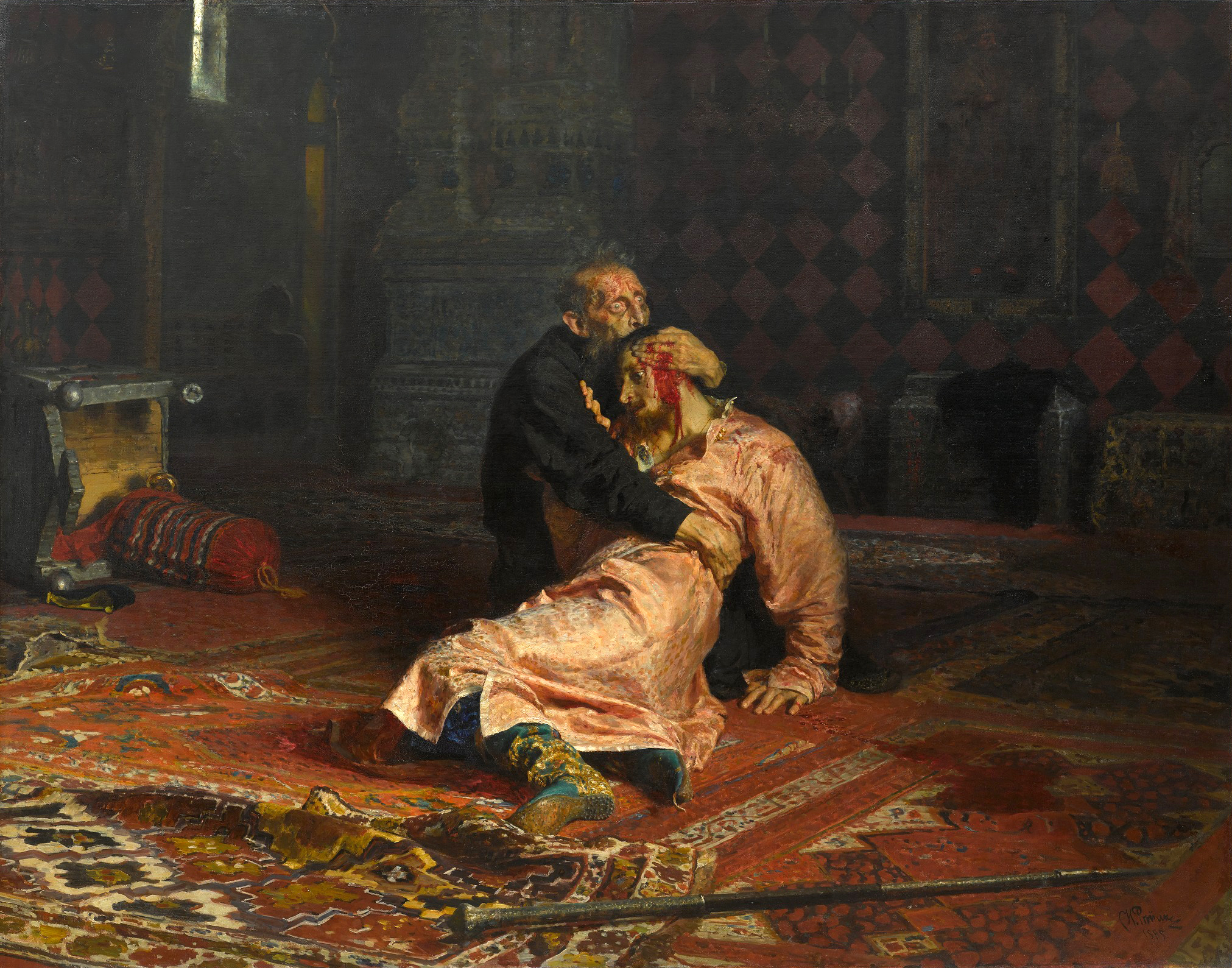
History paintings abound, even blood-soaked ones. Yet in the vast 400-year empire, few dynasties were as perpetually violent as Russia’s Tsars. Since Ivan IV (the first Tsar), father killing son, sibling murdering sibling, imprisonments were commonplace. Ivan the Terrible killed his own son over a trivial matter, then wept bitterly over his act.
By the late 19th century, Russia was still killing their own children. Herzen swore oaths in Red Square, Tolstoy suffered for truth, countless nameless ones perished in Siberian exile. Russia slaughtered them, then mourned them. But grief never lessened the killing. This was the curse begun with Ivan IV: history’s tragedy is not past events, but the follies we repeat.
If the Barge Haulers and Religious Procession showed peasants’ suffering, then They Did Not Expect Him portrayed Russia killing their intellectual sons. Repin, like his friend Tolstoy, pitied them: when haulers suffered, he was a hauler; when peasants suffered, he was a peasant; when intellectuals were exiled, he was an intellectual.

In 1890, Russia’s tolerance finally ended. Repin left his beloved and hated homeland, settling in Finland. There, he wrote Far and Near. Only from afar, he said, can one see both far and near. “There is nothing purer than the silence of the countryside.”
He was undoubtedly content with quiet rural life. Yet in his paintings, Ukraine’s dances were closer to his heart. Lacking money for large canvases, he painted from memory on linen; the red figures, red clothes, red dance, red melody of the Ukrainian Hopak. His body remained in distant Finland, but his heart danced at home.
He finally reconciled with himself and his homeland in memory. In What Freedom!, a couple in formal dress rejoices in the waves.

In old age, Repin lacked both money and strength to paint further. He lived on, and he himself became the masterpiece. Painting no longer mattered to him. We remember not only his works of compassion, but also the compassionate man himself – one who had mercy for all, except for himself.
Leave a Reply