1. Objective
To compare three simple home-friendly methods for measuring wind speed.
2. Methods (Principles and Procedures)
2.1 Cup Anemometer (DIY)
Principle:
The cup anemometer operates on the principle that wind exerts force on hemispherical cups, causing rotation. The rotational speed is proportional to the wind speed (v ∝ N/t, where N is the number of rotations in time t). If the radius of rotation r and calibration factor k are known, the wind speed can be estimated by:
V = k · (2πrN / t)
Method:
• Construct a three- or four-cup anemometer using lightweight plastic cups and rods.
• Mount the device on a low-friction spindle to reduce resistance.
• Count the number of rotations over a fixed time (e.g., 30 seconds).
• Convert the rotations into wind speed using a calibration constant (from comparison with known wind speeds).
2.2 Ribbon Angle Method
Principle:
Wind deflects a light ribbon from the vertical, forming an angle θ. The balance of forces gives tan θ = F_horizontal / F_vertical. The horizontal force is proportional to wind pressure: F_horizontal ∝ (1/2)ρv²A. Thus, θ can be related to v through calibration.
Method:
• Suspend a light ribbon or string from the top of a vertical rod.
• Measure the deflection angle θ from the vertical using a protractor.
• Use a pre-established angle-to-speed calibration curve (obtained from comparison with a reference instrument).
• Take 5–10 quick readings and average them to reduce random noise.
2.3 Time-of-Flight (Bubble/Leaf Drift)
Principle:
Over a fixed distance d, a bubble or lightweight object drifts with the wind. Measuring the travel time t gives the wind speed:
V = d / t
The main error source is human reaction time in stopwatch measurements.
Method:
• Mark a fixed distance on the ground (e.g., 5 meters).
• One person releases a bubble, balloon, or leaf, while another times its passage.
• Start timing as the object crosses the start line, and stop at the end line.
• Repeat multiple trials (≥10) and compute the average wind speed.
• Compare results with a standard anemometer for calibration.

3. Results

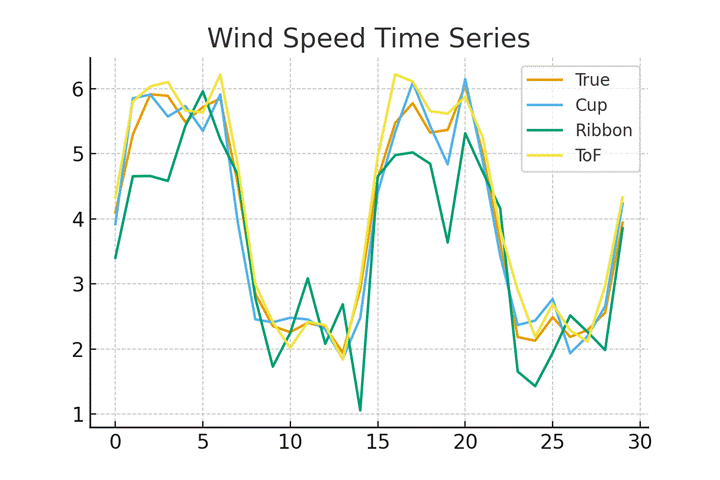
Figure 1. Time series comparison.

Figure 2. Error distribution.

Figure 3. Parity plot.
4. Discussion
Cup Anemometer: reliable overall, slight under-reading at low speeds.
Ribbon Angle: larger noise at low speeds due to nonlinear conversion.
Time-of-Flight: accurate but timing error critical.
Ranking: ToF ≈ Cup > Ribbon.
5. Conclusion
Calibration improves all methods. Time-of-Flight and Cup are most practical.
Leave a Reply